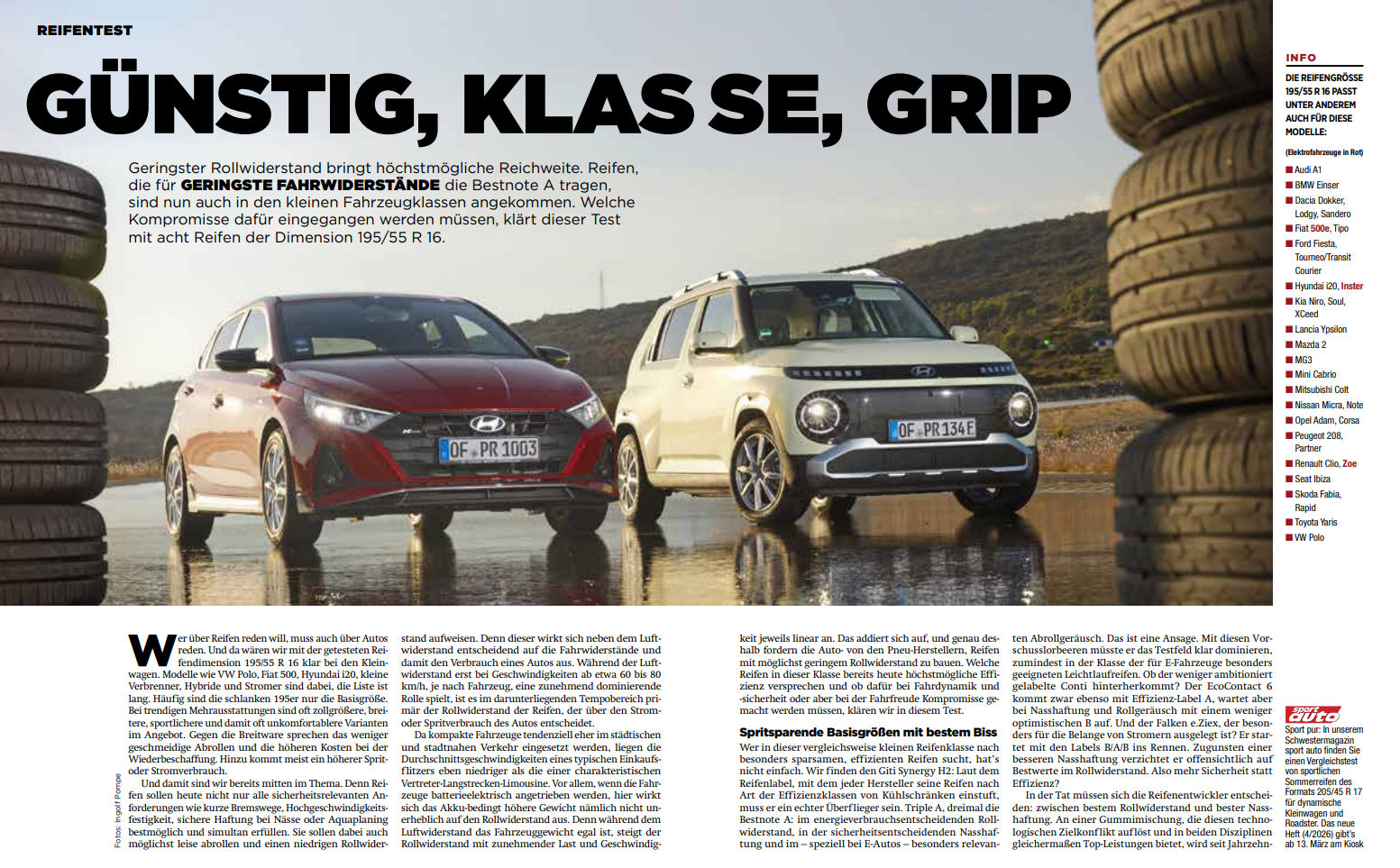
The tyre size 195/55 R16 is frequently a standard fitment on small cars such as the Fiat 500, Hyundai i20 and VW Polo. These are vehicles that typically spend most of their lives driving around town, conditions in which aerodynamic drag doesn’t significantly affect fuel economy and battery range. But rolling resistance does, particularly in heavier electric vehicles. For this reason, modern tyres must reduce this to a minimum while simultaneously meeting all safety-related requirements. With this in mind, Auto motor und sport (ams) examined eight tyres in this size for its summer 2026 test, giving each candidate an overall score and an EV-specific score.
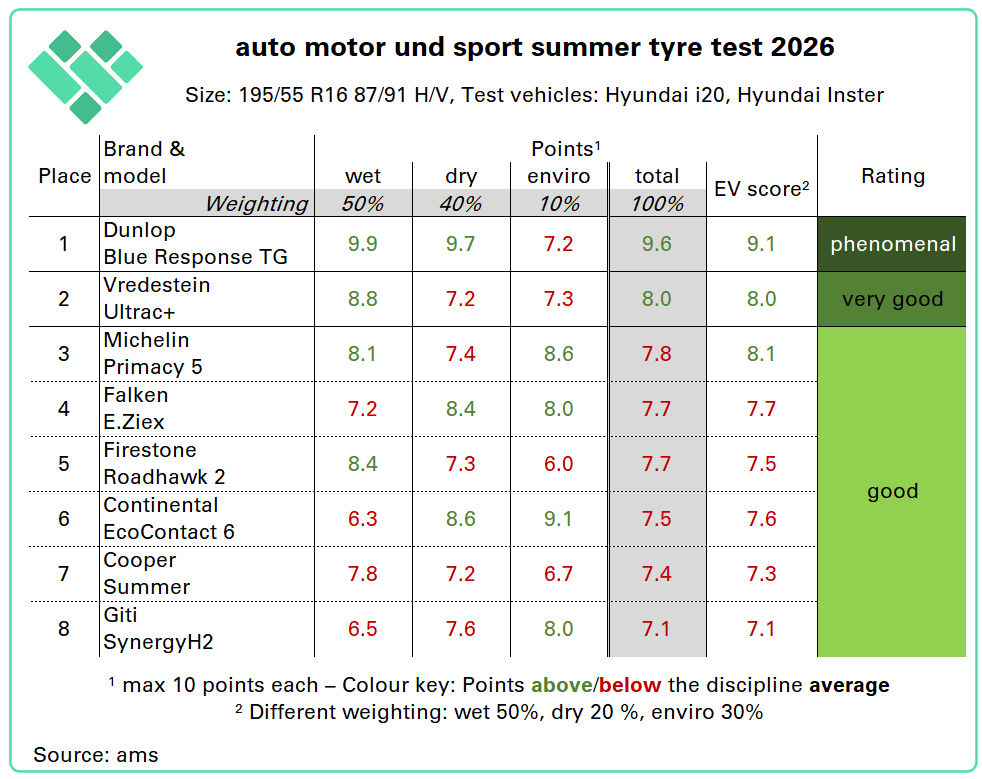
One of the eight is the first Dunlop tyre for Europe developed by the brand’s new owner, Sumitomo Rubber Industries, and the Dunlop Blue Response TG begins its career with a test win and an enviable ‘phenomenal’ rating. None of its rivals could quite match the newcomer in the wet and dry safety disciplines, and despite a modest score for rolling resistance, ams tester Thiemo Fleck declared that “as the new Dunlop shows, even a ‘bread and butter’ tyre size can deliver plenty of driving pleasure alongside the essential safety features.”
As for the seven remaining tyres, runner-up the Vredestein Ultrac + gained a ‘very good’ rating while ams declared the other six to be ‘good’.
Commenting on the tyres he tested, Fleck noted that “even the greatest tyre wizards have their limits,” and this is something that becomes all the more apparent with narrow tyre sizes that typically don’t receive the development and production budget of their sportier siblings. His plea to tyre makers is that “even standard sizes for small cars deserve some attention through the transfer of innovation.”
Rated phenomenal
Test winner – Dunlop Blue Response TG
+ Outstanding grip on wet and dry asphalt; precise, responsive steering and very stable during lane changes. Safe, wide limit range.
– At the limit it is generally slightly understeering, somewhat sensitive to load changes (can oversteer); very high rolling resistance and fuel consumption.
Rated very good
Vredestein Ultrac +
+ Safe driving characteristics with very short braking distances in the wet.
– Quite safe, but not very precise in cornering; high rolling resistance. Noticeable squeal noise.
Rated good
Michelin Primacy 5
+ Very well balanced, safe driving behaviour on dry roads and especially on wet ones. Very good aquaplaning resistance.
– Longer braking distances on dry asphalt; somewhat unstable during sudden evasive manoeuvres. Comfort weaknesses due to limited damping.
Falken e.Ziex
+ Safely understeering, but somewhat critical behaviour; good reserves on dry asphalt. Very good ride comfort.
– Slightly longer braking distances in the wet; not very stable and somewhat sensitive to load changes in wet corners.
Firestone Roadhawk 2
+ Balanced, dynamic wet performance with good aquaplaning reserves; good cornering safety on dry asphalt.
– Slightly delayed steering response; higher rolling resistance and tyre noise; minor shortcomings in ride comfort.
Continental EcoContact 6
+ Extremely low rolling resistance and energy-efficient tyre; very quiet running. Safe, stable cornering behaviour on dry roads.
– Due to the low rolling resistance design, clear weaknesses in wet conditions; longer braking distances even on dry roads.
Cooper Summer
+ Safe, precise and reliable handling on both wet and dry roads. Very good aquaplaning protection; good ride comfort.
– Slightly longer braking distances on wet roads; also weaker on dry asphalt. Some instability in corners; increased rolling resistance.
Giti Synergy H2
+ On dry roads somewhat sluggish and imprecise, but still safely and easily controllable. Comfortable ride.
– Due to its rolling-resistance-optimised design, it has weaknesses and long braking distances in the wet. Noticeable vibration at the limit.